




le-campement_63283_product
le-campement_63283_product le-campement-63283-1 le-campement-63283-1-1-1

Le Campement

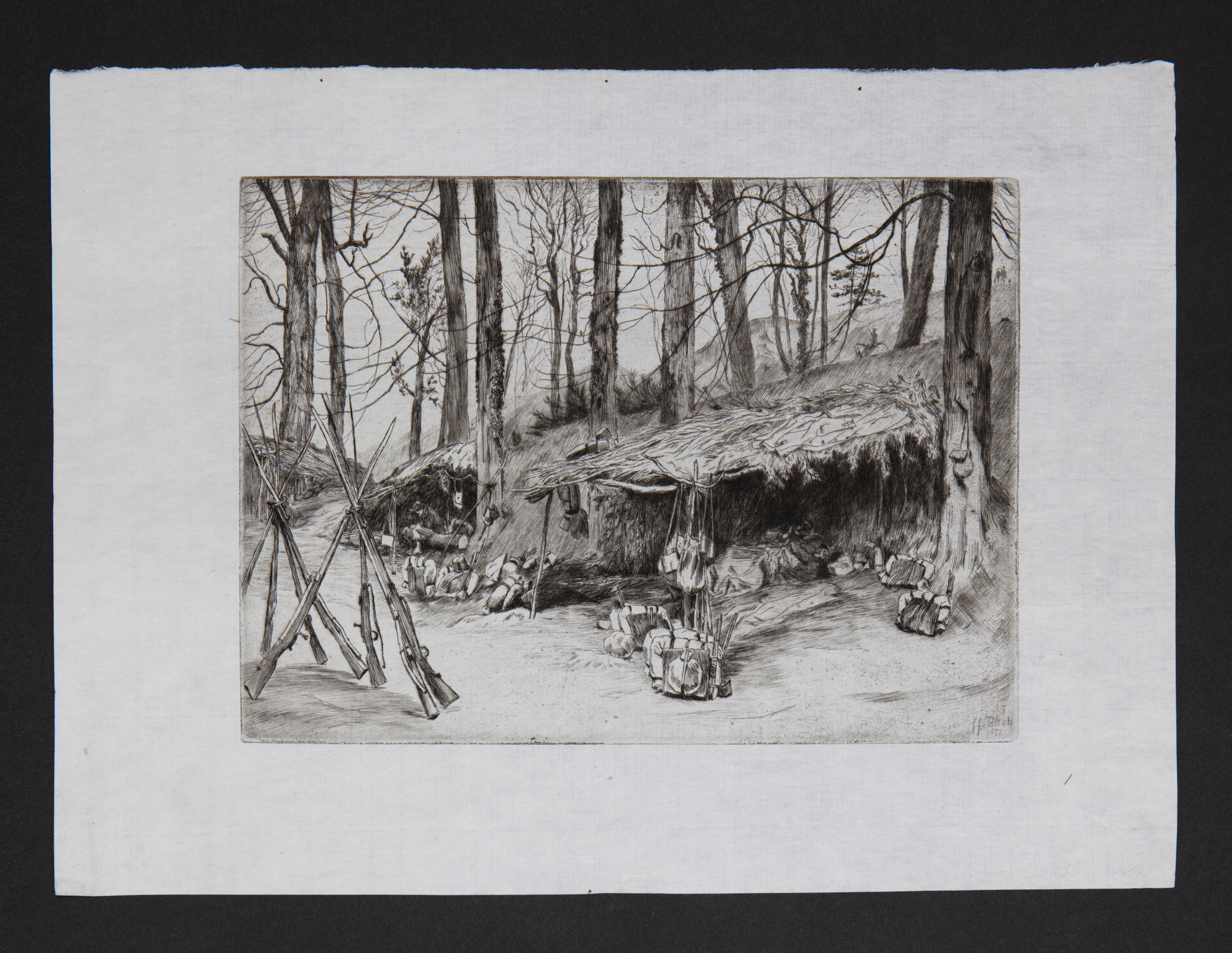
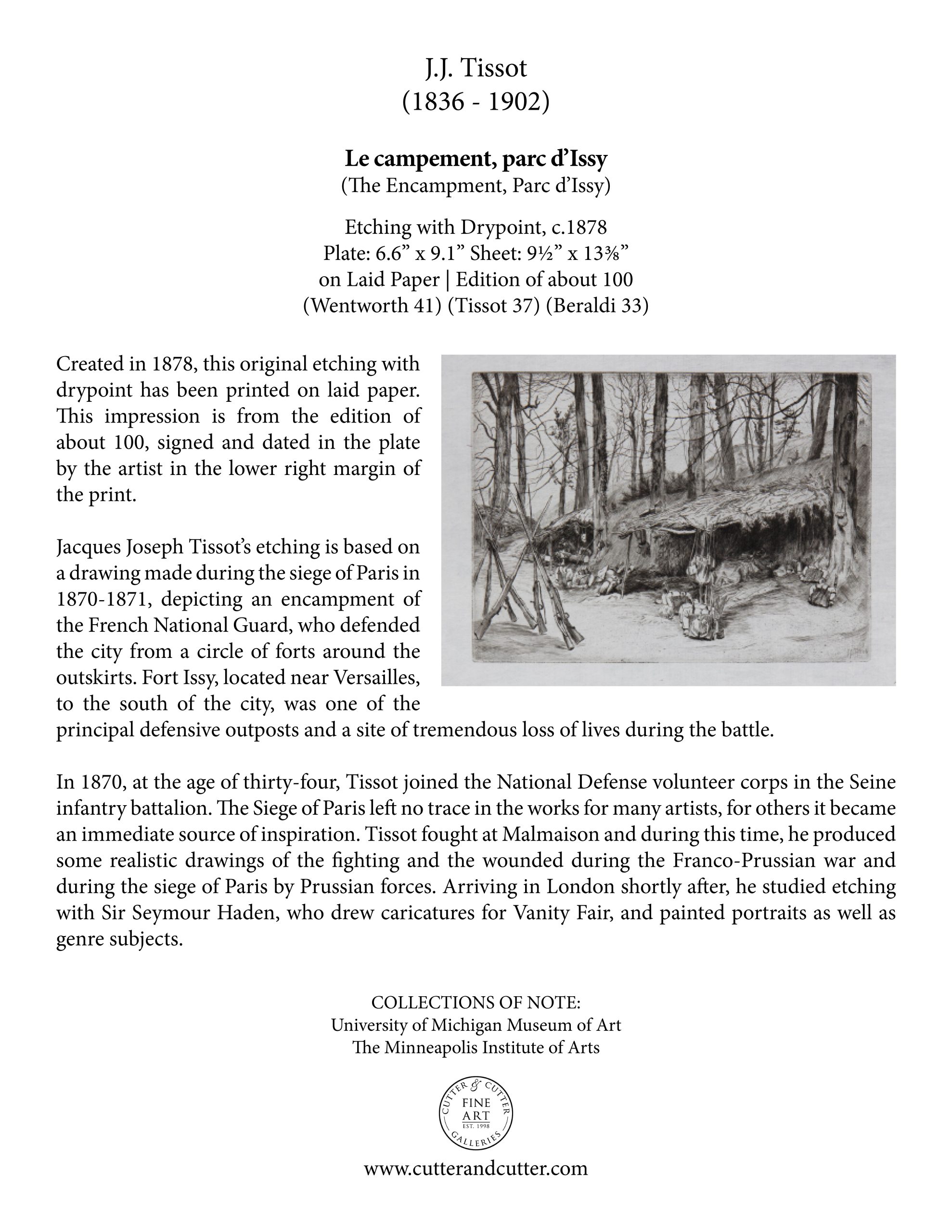
Le Campement, Etching on Laid Paper, c.1878, Plate: 6.6" x 9.1"
Only State from the Edition of about 100

This etching belongs to one of Tissot’s most personal and historically charged bodies of work: his reflections on the Siege of Paris (1870–71) during the Franco-Prussian War. The title The Encampment, Parc d’Issy (Souvenir of the Siege of Paris) tells us that the scene depicts a moment Tissot witnessed or recalled from those harrowing months when the city was surrounded, cut off, and pushed to the limits of endurance.

Parc d’Issy, located southwest of Paris near Issy-les-Moulineaux, was a strategic zone used by French troops and National Guard units. Encampments like the one Tissot shows here were common during the winter of 1870–71, when soldiers and volunteers occupied makeshift positions around the city’s perimeter.

Tissot himself served in the Garde Nationale, and his wartime experiences deeply marked him. While he is best known today for elegant society scenes, this small group of Siege-related prints is far rarer and carries a greater emotional weight. They blend firsthand observation, memory, and Tissot’s signature attention to detail.

SKU: M-TISSOT-122002 Artist: Tag:
Nicole Wolff
Gallery Director

In genre portraits of fashionable, high-society women in the late 1800s, James Jacques-Joseph Tissot captured the charming elegance of his social world by documenting the costumes, decor, and events of the elite. A painter, printmaker, and enamelist, Tissot was a student of Hippolyte Flandrin and Louis Lamothe at the École des Beaux-Arts in Paris, but later relocated to London after fighting in the Franco-Prussian war, where a caricature gig at Vanity Fair granted him entry to the elite society that would ultimately define his subject matter. Upon meeting his wife and muse Kathleen Newton, Tissot drastically altered his lifestyle and subject matter to trade his social life for domesticity, and upon her death, a heartbroken Tissot returned to Paris with a subsequent interest in religion and spirituality that was reflected in his work thereafter.